Digital Workout Partners Help You Get Results
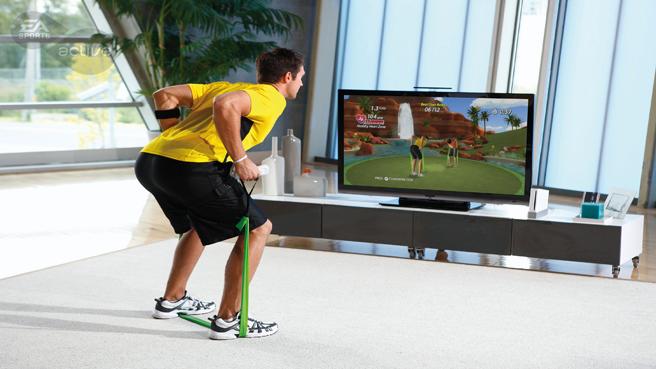 Does your wacky schedule require that you workout alone? Just rather workout alone for your own reasons? Don’t sweat it. You can get as good or better results by training with a digital or on-screen partner. A recent study from Michigan State University shows that working out with a digital companion improves motivation and inspiration during exercise.
Funded by Health Games Research - Robert Wood Johnson Foundation, the study is the first to investigate a theory called the Kohler effect, on the motivation of the participants in health video games. The Kohler effect supposedly explains why lesser team members perform better within a group than they do when playing by themselves.
This research will be published in an upcoming issue of the Journal of Sport and Exercise Psychology so there is probably reason enough to attach some weight to its premise.
The lead scientist of the study is Deborah Feltz, chairperson of MSU’s Department of Kinesiology. “Our results suggest working out with virtually present, superior partners can improve motivation on exercise game tasks,” Feltz said. “These findings provide a starting point to test additional features that have the potential to improve motivational gains in health video games.”
It makes sense that people would react this way and is a plus for programs like P90X and Beach Body and even lesser quality programs.
By incorporating design features based on the Kohler effect, health video games could motivate vigorous exercise, she added.
“One of the key hurdles people cite in not working out is a lack of motivation,” Feltz said. “Research has shown working out with a partner increases motivation, and with a virtual partner, you are removing the social anxiety that some people feel working out in public.”

A plank exercise that strengthens core abdominal muscles were used to determine if a digital/screen companion would motivate people to exercise harder, longer or more frequently. Feltz and her research team used the Eye Toy camera and PlayStation 2 in testing with 200 individuals in the study.
Participants carried out the initial series of five exercises by themselves holding every posture for as long as they were able. After a rest interval, they were told that they would perform the remaining exercises with a same-sex digital partner that they could watch during their performance. This is crucial: the team made certain that the digital partner’s performance of the exercises was always better than the participant’s.
The results showed an increase in the determination that was significantly greater in all testing conditions; individuals that exercised with a more proficient digital partner performed the exercises 24% longer than those people exercising alone.
These results are probably not a surprise to many. A common belief or truism in life itself states that to improve your performance in a certain area, it’s best to surround yourself with people that perform within that area better than you do. Your competence will naturally rise in that environment. But the maxim has not been analyzed this way that we know of until this research.
“The fact that this effect was found with a virtual partner overcomes some of the practical obstacles of finding an optimally-matched partner to exercise with at a particular location,” Feltz said.
In real life, flesh and blood partners can be more of a hindrance than the help.”Individuals can become discouraged if they believe they can never keep up with their partner, or on the other hand, become bored if their partner is always slower,” Feltz said. “With a virtual partner, this can be addressed.”
As an element of its Health Games Research, Robert Wood Johnson Foundation supports fact-based research that explores and documents how digital-type games can and are improving fitness and health care. The group has awarded more than 10 million dollars.
Health Games Research was Founded in 2007 and currently funds 21 research studies on entertaining, effective health games and technologies that improve health behaviors and outcomes. For more information, visit
www.healthgamesresearch.org
www.healthgamesresearch.org
If you’re interested further, below is one of the group’s presentations and here is a link to more of their material.


Comments
Post a Comment